
Capture readings from patient-owned medical devices without uploading the source image by default.
A privacy-conscious mobile architecture for remote-care and healthcare products, designed to turn visible device readings into user-confirmed structured data while reducing hardware-integration dependencies and keeping raw health imagery inside the phone whenever the selected device and model can support local processing.
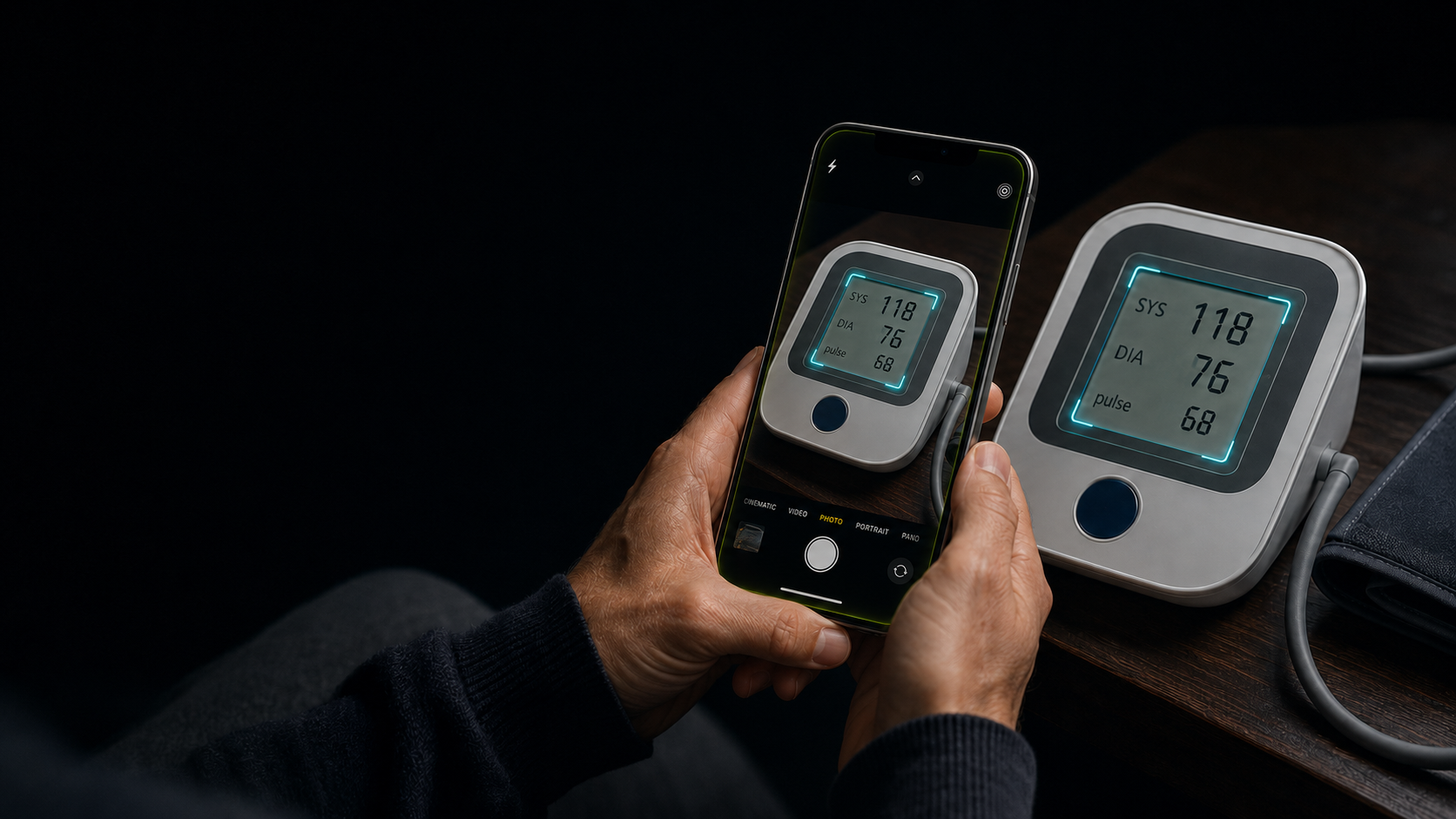
The product decision is not simply whether AI can read the screen. It is where that screen is allowed to be read.
For founders building in healthcare, architecture becomes part of the value proposition. The system must make capture easy for patients, integration predictable for engineering teams, and data boundaries clear enough for enterprise buyers to trust.
Current implementation status
Subra AI currently supports private on-device chat and general image inference. Images can be analysed without making a cloud AI service the default processing path.
A cloud-assisted proof of concept has successfully extracted structured readings from medical-device displays using a React Native application, a controlled backend function, managed identity, and an AI agent.
The dedicated medical-reading capture workflow—including device-display detection, field extraction, review and correction, structured JSON generation, and device-class benchmarking—is the next implementation task.
Important clarification: This article presents the intended privacy-conscious product architecture and pilot plan. It does not claim that the complete on-device medical-reading workflow is already available in the released application.
What device-agnostic means: Device-agnostic describes the camera-based input approach, not guaranteed compatibility with every medical device. Accuracy must be progressively validated by device class, display technology, lighting condition, unit format, and supported mobile hardware.
Best suited for
This architecture is best suited for remote patient monitoring, virtual-care, chronic-care, home-health, and healthcare data-capture products that need to accept readings from heterogeneous patient-owned devices without depending exclusively on Bluetooth integrations or uploading raw health images by default.
- Remote patient monitoring platforms
- Virtual clinics and chronic-care programmes
- Home-health and elderly-care applications
- Digital therapeutics and rehabilitation products
- Privacy-focused wellness and personal-health applications
- Healthcare platforms that must support mixed or older device fleets
Not intended as: This is not a replacement for clinically certified device integrations where direct, validated connectivity is required. It is an additional capture path that must be validated for the intended device classes, users, and clinical workflow.
Healthcare apps want a complete view of the patient: wearable activity, medical records, home-device readings, notes, and AI-generated guidance. Each new connection can make the experience more seamless. It can also move sensitive data across another vendor, storage layer, retention policy, and regulatory boundary.
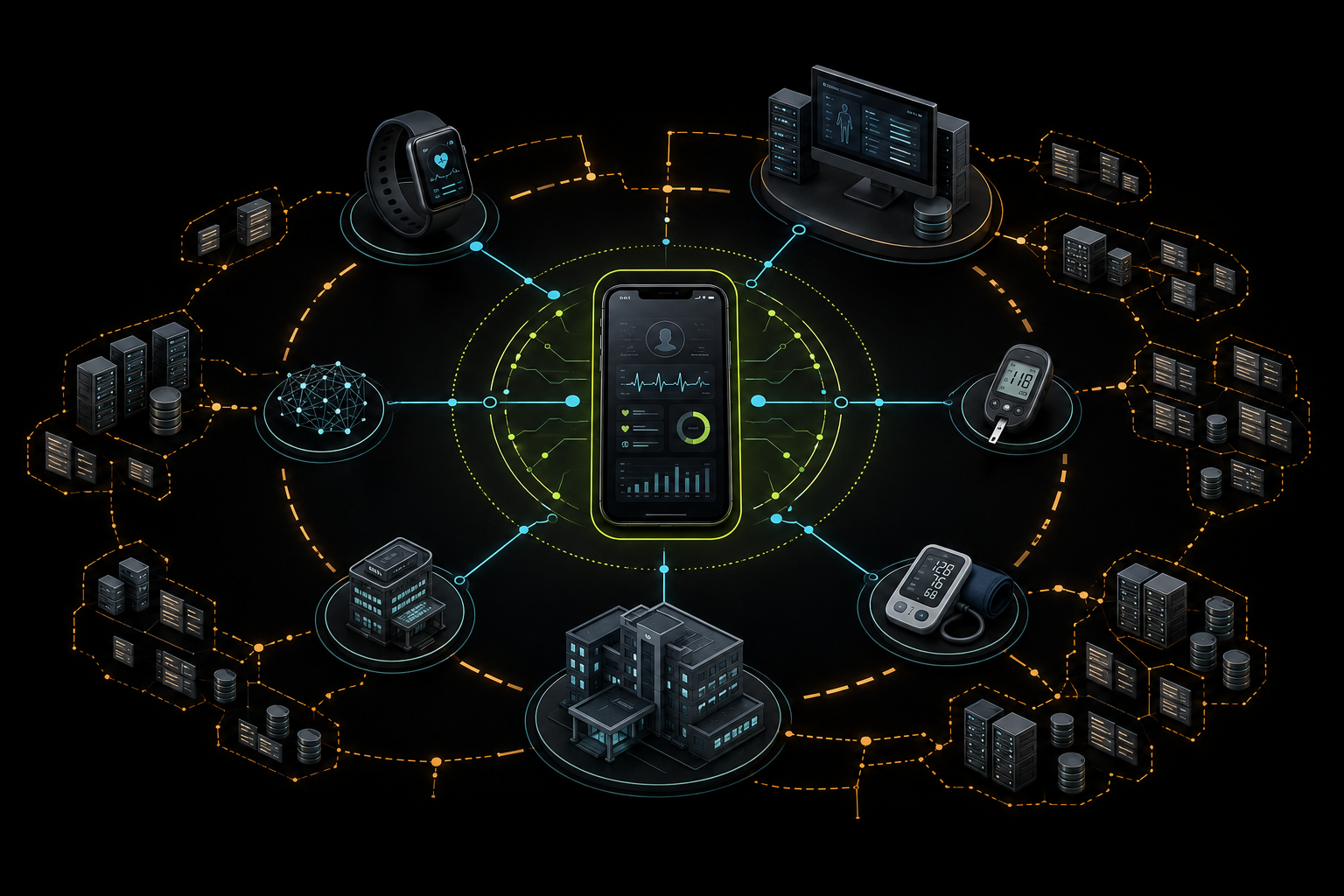
“Encrypted in transit” is a transport control, not a complete privacy strategy. A founder still needs answers to harder questions: Did the image need to leave the phone? Is the raw image retained? Can a processor use it for model improvement? What happens when consent changes? Which party owns deletion?
The customer problem is simpler
A patient already owns a working device. A camera-based input path can reduce dependence on a particular Bluetooth model, a new account, or a manual multi-field form. The business opportunity is to broaden useful coverage progressively—without treating every camera frame as cloud data or assuming every device is already supported.
For a founder, healthcare product leader, or CTO, the investment case is broader than model capability. A carefully validated capture workflow could expand product coverage while preserving direct integrations where they remain the better choice.
Patients could capture readings from devices they already own instead of every user needing to purchase newly integrated hardware.
A camera-based workflow can extend coverage to devices without Bluetooth, SDK, or API access, while direct integrations can remain available where they provide better reliability.
Guided capture and user confirmation may reduce typing effort, unit-selection mistakes, and incorrectly transcribed values.
Healthcare and home-care platforms may support more patients, including people using older or lower-cost devices.
Where local processing is supported, the system could submit reviewed structured measurements instead of storing or transmitting the original health-related image.
A visible “processed on device” or “raw image not uploaded” promise may improve user trust and strengthen enterprise conversations when the implementation consistently honours it.
The pattern could be progressively evaluated for blood-pressure monitors, glucose meters, thermometers, pulse oximeters, weighing scales, and other display-based devices.
The intended architecture assigns work according to sensitivity and capability. Device-side processing would handle capture, device classification, value extraction, unit normalization, timestamp detection, confidence scoring, and optional redaction. The app would present the structured result for human confirmation before anything is submitted.
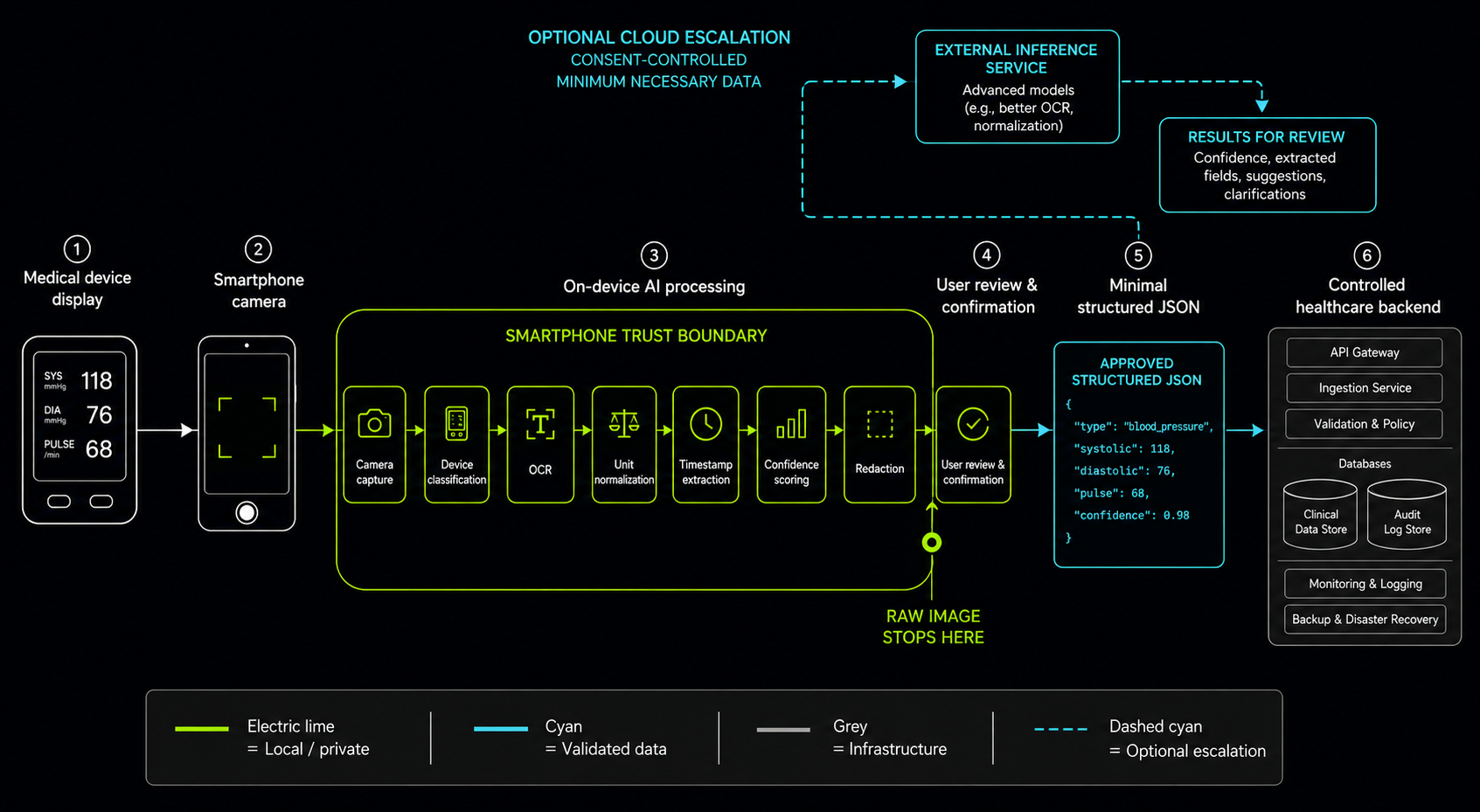
React Native orchestrates the boundary—it does not hide it
In this design, React Native would coordinate camera state, wearable ingestion, consent, lifecycle, offline queues, error recovery, and the review UI. Native modules would own model execution and platform-specific resources. A typed boundary would return a versioned structured result to JavaScript, where runtime validation could reject malformed or unsupported payloads before persistence or backend submission.
Cloud-assisted inference and services may remain valuable for longitudinal analysis, clinician collaboration, advanced reasoning, and workflows that require shared state. In the proposed hybrid architecture, the backend should receive only the minimum user-confirmed fields needed for that job—not the source image simply because uploading is convenient.
The planned mobile flow is intentionally short. The user would scan the display, see what the model understood, review and correct every extracted field, and approve the submission. On-device processing is intended to produce the first useful result without waiting for an upload or a stable connection.
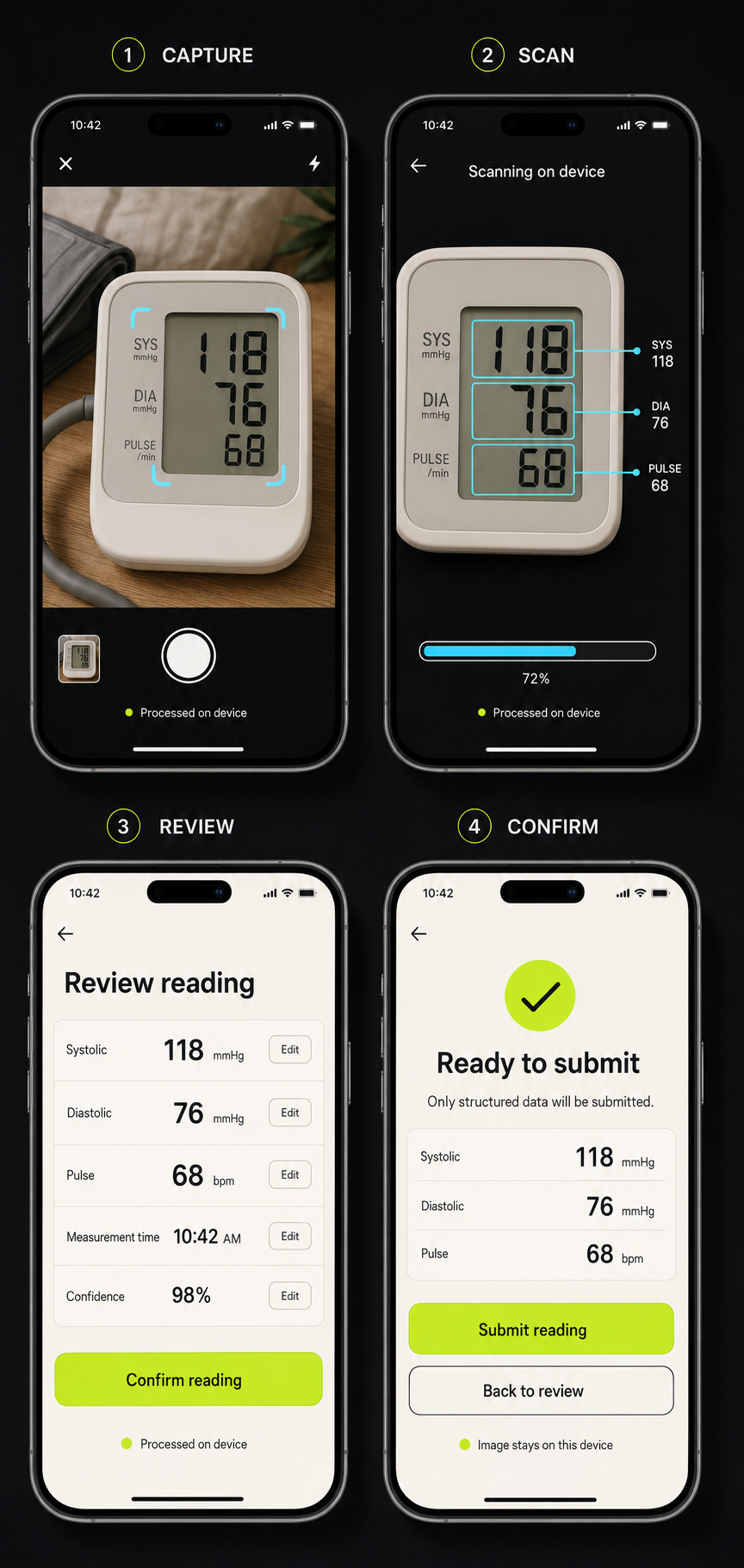
Visual guidance helps the user align glare-prone LCD and LED displays.
The supported local extraction pipeline would identify device category, readings, units, and any visible measurement time.
Low-confidence or inconsistent fields require recapture or explicit confirmation instead of silent acceptance.
Only the user-confirmed structured payload would enter the app's controlled backend workflow.
If a measurement time is visible, the planned workflow would extract it and label the source as device_display. Otherwise, it would use capture time and record capture_time. That provenance would prevent a convenient fallback from masquerading as an exact clinical timestamp.
A confidence score represents how certain the extraction system is that it correctly interpreted the visible display. It does not establish whether the medical device itself is accurate, or whether a measurement is clinically normal, safe, or appropriate. Those are separate questions outside the extraction layer.
The system should preserve what it can actually see rather than silently changing a medically unusual value because it appears statistically unlikely. Every extracted field must remain reviewable and correctable before submission. Format validation and clinical interpretation must remain separate concerns.
Mark obscured fields as incomplete and require recapture or explicit field-level confirmation.
Do not infer through an unreadable region; ask for a clearer capture before submission.
Present the possible unit as unresolved and require the user to confirm it or recapture the display.
Flag the structural inconsistency for review; never silently swap the extracted values.
State that the layout is unsupported and offer recapture, manual entry, or a validated direct-integration path.
Show the extracted value unchanged, label it for explicit confirmation, and do not reject or “correct” it solely for being unusual.
Record capture time with clear provenance rather than inventing a device-displayed timestamp.
Flag the conflict and require recapture or explicit confirmation of the affected fields.
Encryption is required, but minimization is the stronger starting point. If raw camera imagery is not necessary outside the device, the safest retention period is zero and the safest third-party permission is none.
Threats worth designing for
Prompt injection does not apply in the same way to every extraction pipeline. Constrained OCR followed by deterministic parsing does not interpret visible text as instructions, although it still needs robust parsing and input validation. When a multimodal generative model interprets an image, however, every visible word must be treated as untrusted input. Text in the image must never override system instructions, the extraction schema, allowed fields, or permitted backend actions.
Other risks include screen captures in logs, analytics events containing health values, model files replaced at runtime, replayed submissions, stale consent, debug builds with broader storage, and unbounded offline queues. Schema validation reduces malformed-data risk but is only one control within a broader design that also needs signed model assets, least-privilege permissions, log redaction, protected local storage, authenticated requests, replay resistance, and testable deletion behaviour.
Treat model output as untrusted data. Parse it into a strict, versioned schema and reject unknown fields.
Validate types, units, required fields, and allowed measurement categories against allow-listed measurement types and units.
Do not execute instructions found in an image or allow extracted text to select tools, network requests, or backend actions.
Keep image interpretation isolated from backend command execution; a parsed reading is data, not authority to perform an operation.
Require user review before submission and record the extraction pipeline and schema version with the result.
That position may reduce hesitation for patients and strengthen conversations with hospitals, insurers, and enterprise buyers—but only after the implemented extraction, telemetry, fallback, and support paths have been verified to honour it.
A production implementation may use a bundled model, a securely delivered model, deterministic vision or OCR components, or a constrained hybrid pipeline. The choice should depend on supported devices and measured reliability; remote model delivery is an operational option, not a default requirement.
Store the model or extraction-pipeline version and the schema version with every result. A model update must not silently change field meaning or units.
Validate each candidate against the supported device matrix and defined memory, battery, latency, and thermal limits before activation.
Roll out by app version, device capability, operating system, or user cohort, and retain a tested rollback path for regressions.
Use integrity and authenticity checks for downloaded assets before loading them. Delivery controls should match the sensitivity and risk of the workflow.
When a local model is missing, incompatible, or unavailable, provide a clear fallback. Any cloud escalation must remain controlled, consent-aware, and visible to the user.
Track correction rate, recapture rate, unsupported-device rate, and low-confidence frequency by pipeline version and supported device class.
Model execution can propose structured data; it must remain separate from authorization to submit data or perform healthcare-backend actions.
These are proposed acceptance metrics, not measured production results. A founder-level scorecard should evaluate the complete workflow across a documented matrix of device classes, display technologies, lighting conditions, unit formats, operating systems, and target phones.
- Field-level accuracy by measurement type
- Device-class success rate
- Unit-recognition accuracy
- Unsupported-device detection rate
- Correction rate
- Recapture rate
- Time from camera opening to confirmed reading
- Abandonment rate during capture
- p50 and p95 inference latency
- Peak memory usage
- Battery impact
- Thermal behaviour
- Supported-device coverage
- Percentage of captures completed without transmitting the raw image
- Amount and type of data submitted to the backend
- Cloud-escalation frequency
- Raw-image retention rate, ideally zero by default
- Crash-free capture sessions
- Model-unavailable fallback success
- Schema-validation failure rate
- Regression rate after model updates
No accuracy, latency, privacy, or cost result should be presented publicly until it has been measured against a documented device matrix and test protocol.
A leader's job is not to maximize local inference at any cost. It is to place each capability where customer value, privacy risk, reliability, operating cost, and team complexity balance correctly.
If privacy is part of positioning, define the allowed data flows before selecting model or vendor.
A review step creates user agency and supplies the correction signal needed to improve the system responsibly.
Use it where shared context or advanced reasoning creates clear value, not as the default route for every frame.
Extraction pipelines can change independently while mobile and backend teams rely on a stable, versioned schema.
Privacy architecture can reduce enterprise risk, shorten security conversations, and differentiate the product.